Are these SiteBuildHub customer statistics?
No. SiteBuildHub does not claim proprietary customer survey data here. The page provides clearly labeled editorial benchmarks and adjustable frameworks for contractors to assess their own workflow.
Public Benchmark Notes
A transparent benchmark resource built without invented surveys. Use the frameworks to measure your own documentation, adoption, client communication, and implementation quality.
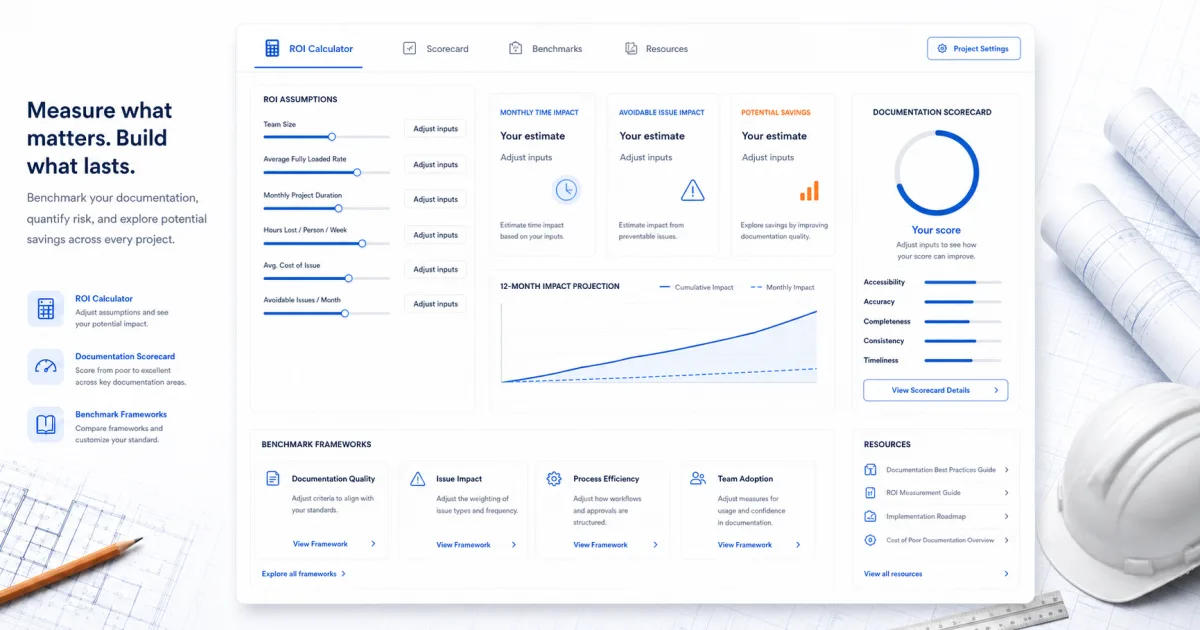
This is not a proprietary survey report. SiteBuildHub has not measured a representative population of contractors and does not publish invented percentages. The page offers public benchmark notes and editorial frameworks that teams can apply to their own records.
A benchmark is useful when its definition is stable. Before measuring, define the event, owner, time period, included projects, and source system. Record the baseline before introducing software or changing the workflow.
The table is a measurement framework, not a claim about industry averages. Each contractor can set a baseline and target appropriate to project risk, team capacity, and contract requirements.
| Benchmark area | Measure | Healthy direction | Evidence source |
|---|---|---|---|
| Software adoption | Required workflow completed in the intended system | Increasing completion with fewer parallel records | System activity and spot checks |
| Project documents | Required current records available and complete | Fewer missing fields and duplicate masters | Project file audit |
| Drawings | Current revision clearly identified and distributed | Fewer unresolved revision exceptions | Drawing register and acknowledgment |
| Client communication | Decisions answered by the required date | Shorter unresolved-decision queue | Approval log |
| Change orders | Changed work documented before execution when practical | More complete authorization evidence | Change register |
| Implementation | Pilot workflows passing defined acceptance tests | Fewer critical gaps and workarounds | Pilot scorecard |
Adoption is not the number of purchased users. Measure whether the required action is completed correctly and on time. A login without a usable daily report, approval, drawing acknowledgment, or cost record is not operational adoption.
Common barriers include unclear ownership, excessive required fields, weak mobile performance, duplicate spreadsheets, training too far ahead of use, and reports that do not help the person entering data. Separate product gaps from process, configuration, and training issues.
For documents, audit whether the current scope, drawing, approval, change, and closeout record can be located by someone outside the original conversation. For drawings, track revision identification, distribution, field access, and superseded-file control.
For client communication, measure open decisions, due dates, approval evidence, and whether the client received one understandable current record. Avoid measuring message volume as success; more communication can still be less clear.
A change-order benchmark should assess whether the trigger, scope delta, cost, schedule effect, attachments, and authorization are documented. It should not imply every project can wait for prior approval; emergency conditions require prompt follow-up records.
For software buying, measure requirements demonstrated, exceptions tested, commercial assumptions verified, migration reconciled, and pilot acceptance criteria passed. Product count and feature count are not useful benchmarks by themselves.
Use these resources to turn the framework into a company-specific baseline. Keep assumptions visible and avoid presenting calculator outputs as measured facts.
No. SiteBuildHub does not claim proprietary customer survey data here. The page provides clearly labeled editorial benchmarks and adjustable frameworks for contractors to assess their own workflow.
An exact percentage is only useful when the source, sample, date, geography, and methodology are clear. This page avoids unsupported numbers and focuses on measures a contractor can verify internally.
Track current-version availability, required-field completion, approval turnaround, unresolved exceptions, daily-report completion, change-order authorization, and closeout completeness.
Review operational measures weekly during rollout and monthly after the workflow stabilizes. Compare against the same definitions and baseline.
No. They can support an ROI estimate when paired with company-specific time and cost inputs. Use the ROI calculator as a planning model, not financial advice.
No. Clear records can reduce avoidable ambiguity and improve evidence, but they cannot guarantee outcomes or replace legal, engineering, accounting, safety, or permitting advice.