Why pricing is the most important skill you build
Pricing a construction job is not the same as estimating it. Estimating is figuring out what the job will cost. Pricing is deciding what to charge. The difference between the two numbers is your profit, and that gap determines whether your business survives a slow season, replaces an aging truck, or invests in growth.
Many contractors treat pricing as a formula: costs plus a standard markup equals price. That approach leaves money on the table for jobs where the market supports a higher margin and loses jobs where rigid pricing does not match client expectations. Strategic pricing means understanding your costs deeply, knowing your market position, and setting prices that capture value without pricing yourself out.
The contractors who thrive are not always the ones with the lowest overhead or the fastest crews. They are the ones who understand their true costs and price accordingly. They know their break-even number for every job type, and they make deliberate decisions about which margins to accept and which to walk away from.
Understanding your true cost structure is the foundation of profitable pricing.
Understanding your real costs
Most contractors underestimate their true costs by 15 to 30 percent. The gap usually comes from costs that are real but not obvious: the time spent driving to the supplier, the gas for the crew truck, the wear on tools, the office staff who processed the permit, the phone bill, the liability insurance premium. These costs are easy to ignore because they do not show up on a single invoice the way lumber or siding does.
Your real costs fall into three buckets. Direct costs are materials, labor, and equipment you can trace to a specific job. Indirect costs are the overhead you pay to run your business — office rent, insurance, vehicles, marketing, software, accounting. The third bucket is often missed: the cost of selling. Your time writing estimates, meeting with clients, and following up on bids is real cost that should be recovered in your pricing.
To understand your costs, start with your profit and loss statement from the last 12 months. Divide your total costs into direct and indirect categories. Calculate your overhead as a percentage of direct costs. Then ask yourself: does my pricing model recover all of these costs? If a $50,000 job produces a $5,000 profit on paper but you spent $3,000 of unbillable time selling it, your real profit is closer to $2,000.
Build a cost database for each job type you do regularly. Track the actual material costs, labor hours, and overhead for completed jobs and compare them to what you estimated. The patterns will show you where your pricing is accurate and where you consistently underprice. That data is worth more than any pricing formula.
- Track ALL costs, including indirect and selling costs
- Calculate overhead as a percentage of direct costs from your P&L
- Build a per-job-type cost database from completed projects
- Compare estimated vs actual costs monthly to find pricing gaps
- Include your sales and estimating time as a real cost of doing business
Setting profit margins for different job types
Not every job should carry the same profit margin. A straightforward deck replacement with no surprises and a reliable crew deserves a different margin than a basement renovation where you cannot see all the conditions until the drywall is open. Your pricing should reflect the risk, complexity, and market demand for each job type.
For routine jobs with low risk — deck building, fencing, siding replacement, window installation — target a net profit margin of 15 to 20 percent. These jobs are predictable, the scope is clear, and the competition is often high. Your margin comes from efficiency, not from charging a premium.
For moderate-risk jobs — kitchen remodels, bathroom renovations, basement finishes — target 20 to 25 percent. These projects involve multiple trades, hidden conditions, and client selection decisions that can delay the schedule. The higher margin covers the coordination overhead and the risk of discovering problems behind existing walls.
For high-risk jobs — structural repairs, foundation work, retaining walls, projects with engineering requirements — target 25 to 35 percent. These jobs carry significant risk of unforeseen conditions, and the consequences of getting the price wrong are much higher. If you cannot get 25 percent margin on a high-risk job, consider whether the job is worth taking.
These are baseline targets, not rigid rules. Adjust based on your workload, the client's budget, the competitive landscape, and your strategic goals for the year. When you are slow, you may accept lower margins to keep your crew busy. When you are booked out three months, you can be more selective about which jobs you take and at what margin.
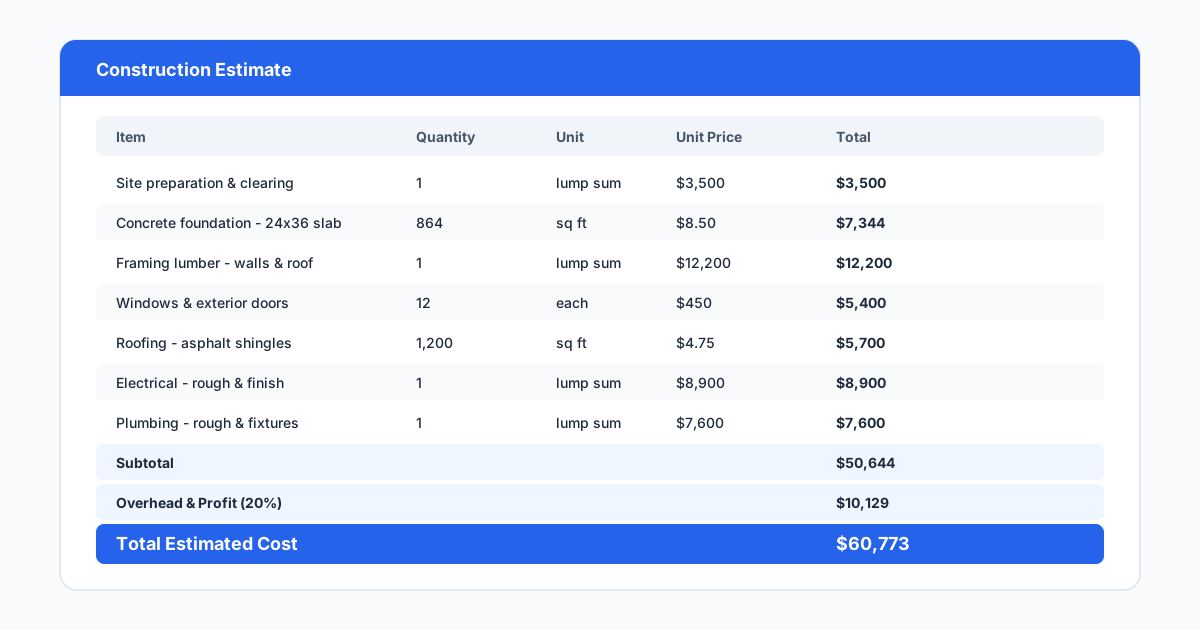
Match your profit margin to the risk and complexity of each job type.
Material markup strategies that work
Markup on materials serves two purposes: it covers the cost of procurement and it contributes to your overhead and profit. Many contractors mark up materials 10 to 15 percent without knowing whether that number is right. The right markup depends on how much work goes into sourcing materials and how much risk you carry for price changes.
If you order materials from one supplier who delivers to the site, and the client selects standard products from a showroom, a 10 percent markup may be reasonable. If you are sourcing specialty materials from multiple suppliers, picking up materials yourself, managing deliveries, and handling returns for damaged items, your markup should be 20 to 25 percent.
Consider using a cost-plus markup model for projects with significant material exposure. In this model, you charge the client the actual material cost plus an agreed markup percentage. This protects you from price increases between the estimate and the purchase, and it gives the client transparency into what materials actually cost. The trade-off is that the client sees your markup, so you need to justify it.
Negotiate volume discounts with your suppliers and keep the savings. If you buy all your lumber from one yard and they give you a 5 percent contractor discount, that discount is part of your pricing advantage. Do not pass it through to the client on every line item unless your pricing model depends on it. The discount is compensation for your purchasing volume and your relationship with the supplier.
Track your material margin by job type. If you consistently achieve a 22 percent effective markup on roofing materials but only 8 percent on landscaping supplies, you have data to adjust your pricing strategy. Some contractors find they can be more aggressive on labor pricing when their material margin provides a comfortable buffer.
- Match markup percentage to procurement effort and material risk
- Use cost-plus pricing for projects with volatile material costs
- Negotiate supplier discounts and retain the savings
- Track effective material margin by job type
- Adjust markup based on whether you handle delivery, storage, and returns
Labor burden calculations every contractor needs
Labor burden is the gap between what you pay a worker and what that worker actually costs. The difference is startling to most contractors when they calculate it for the first time. A framer earning $30 per hour may cost you $44 per hour by the time you include payroll taxes, workers' compensation, health insurance, retirement contributions, paid time off, and tool allowances.
To calculate your labor burden, start with the hourly wage and add all employer-paid costs. Social Security and Medicare (FICA) add 7.65 percent. Federal and state unemployment taxes add 2 to 6 percent depending on your state and experience rating. Workers' compensation insurance varies by trade — framing and roofing can be 15 to 25 percent of wages, while finish carpentry may be 5 to 10 percent.
Add health insurance, retirement contributions, paid time off, holiday pay, training costs, and any other benefits you provide. Divide the total annual cost by the number of hours the employee actually works (not the number you pay for). If you pay for 2,080 hours but the employee works 1,850 after PTO, holidays, and sick days, your burden is calculated against the productive hours.
For most small contractors, the fully burdened labor rate is 1.35 to 1.65 times the hourly wage. A $28 per hour carpenter at 1.45 burden costs you $40.60 per hour. If you are pricing labor at the wage rate, you are losing 30 to 40 percent of your labor cost on every job. That leak alone can turn a profitable year into a break-even one.
- Calculate burden as total employer costs divided by productive hours
- Include FICA, unemployment tax, workers comp, insurance, PTO, retirement
- Apply trade-specific workers comp rates to your calculation
- Use productive hours (not paid hours) for accurate burden rate
- Expect fully burdened rates to be 1.35-1.65x the hourly wage
Pricing different job types: a practical approach
A roofing job and a kitchen renovation require completely different pricing models. Roofing is material-intensive with predictable labor and relatively low client involvement. Kitchens are coordination-intensive with high client involvement, multiple decision points, and significant risk of scope creep. Applying the same pricing formula to both guarantees you will underprice one and overprice the other.
For material-intensive jobs like roofing, siding, fencing, and decks, focus on your material markup and crew efficiency. Your pricing advantage comes from buying materials well and completing the work quickly. Price these jobs at the lower end of your margin range and compete on reliability and speed.
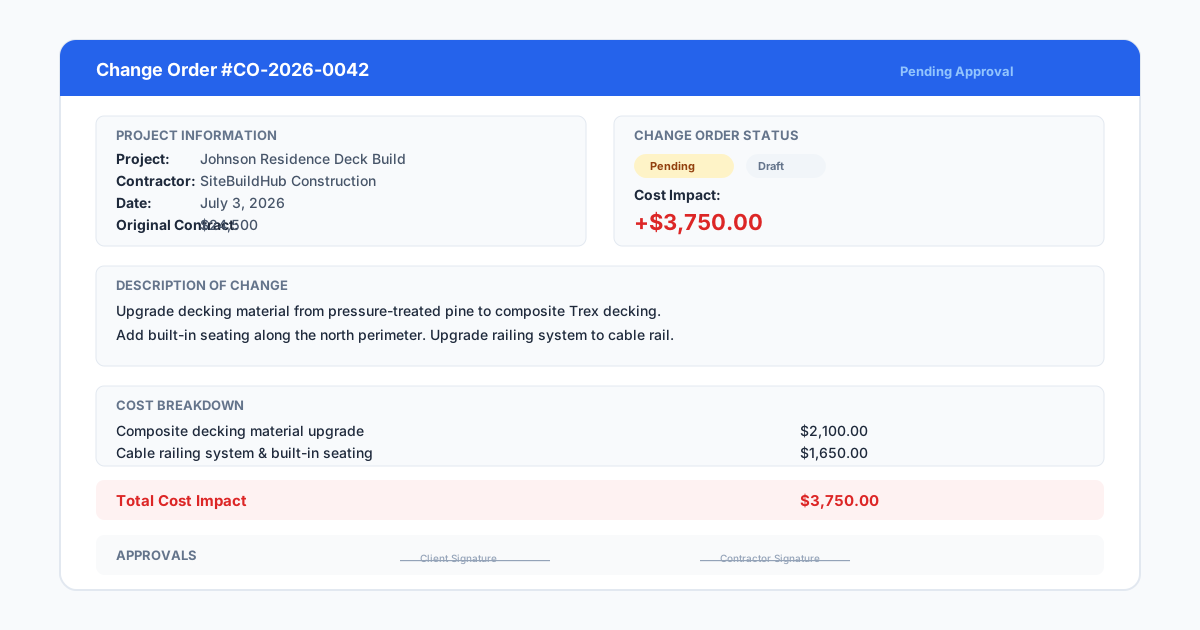
For labor-intensive jobs like remodels, additions, and renovations, focus on accurate labor estimates and change order management. These jobs have more variables and more opportunities for scope creep. Price them at the higher end of your margin range and build clear change order processes into your contract. The profit in renovation work comes from managing the variables, not from material markup.
For service and repair work like electrical, plumbing, and HVAC, use a time-and-materials or flat-rate pricing model. Service work is unpredictable by nature, and trying to bid every repair as a fixed price carries too much risk. Many service contractors use a diagnostic fee plus hourly rates with published price books for common repairs.
For new construction, your pricing depends on whether you are bidding competitive tender or negotiating with a repeat client. Competitive bids often require lean margins with tight scope control. Negotiated work allows higher margins because the relationship and trust are already established. Build your overhead recovery differently for each — competitive bids may need lower overhead allocation to be competitive, while negotiated work should carry full overhead plus a relationship premium.
Match your pricing model to the job type. One formula does not fit all.
Reviewing and adjusting your pricing regularly
Pricing is not a set-it-and-forget-it decision. Material costs change, labor markets shift, your overhead evolves, and the competitive landscape moves. Review your pricing at least quarterly and adjust based on actual job cost data, market conditions, and your business goals.
Track your win rate at different price points. If you are winning 80 percent of the jobs you bid, your prices may be too low. If you are winning 20 percent, you may be too high or targeting the wrong clients. The sweet spot for most contractors is a 40 to 60 percent win rate — enough work to stay busy without leaving significant money on the table.
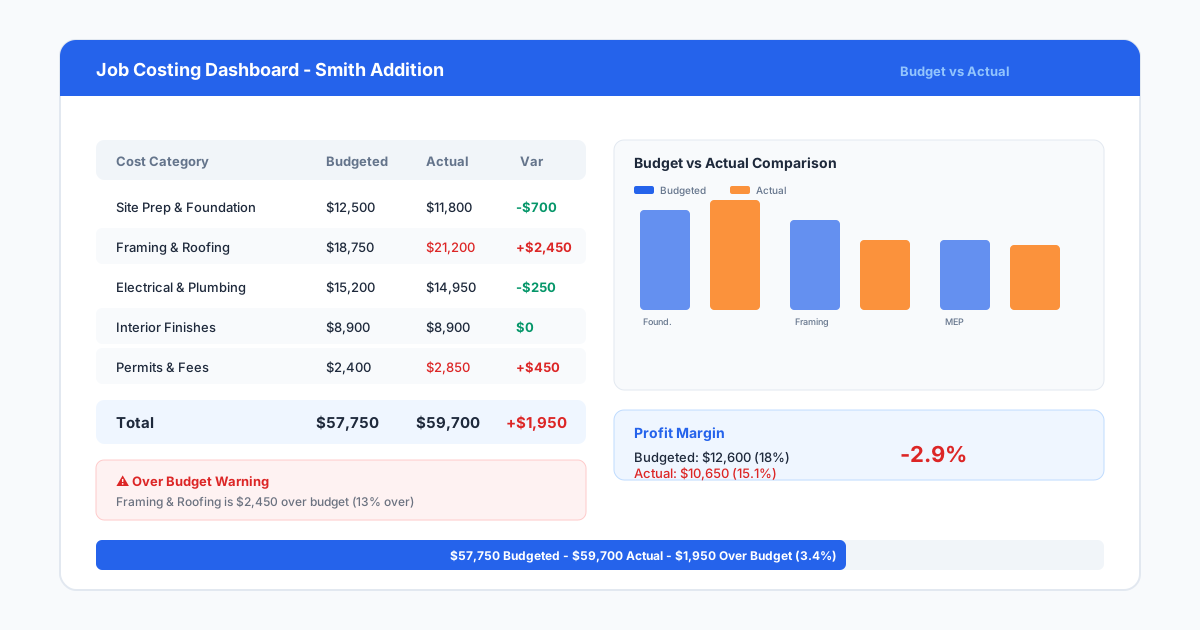
Compare your estimated costs against actual costs for every completed job. Build a spreadsheet that tracks estimated material cost versus actual, estimated labor hours versus actual, and estimated overhead recovery versus actual. The gaps will tell you exactly where your pricing model needs adjustment. If you consistently underestimate labor on bathroom remodels, your pricing for that job type needs to change.
Listen to what the market tells you. If you keep losing bids to the same competitor, find out what they are offering. They may have a more efficient crew, a better supplier relationship, or a different business model. Understanding your competition helps you make strategic pricing decisions rather than guessing at the right number.
- Review pricing quarterly against actual job cost data
- Track win rate and adjust if it falls outside 40-60% range
- Compare estimated vs actual costs for every completed job
- Adjust pricing for specific job types based on historical data
- Study your competition to understand market pricing dynamics